Join Us: A Free Conversation for Parents
Parents: Why Did America Stop Teaching Civics? — And How We Can Help
Thursday, September 24, 2026 | 6:00–6:30 PM CDT (4:00 PM PT / 7:00 PM ET) | Online via Zoom
In this free 30-minute webinar, the O'Connor Institute walks parents through its research on the decline of civics education — why instructional time started dropping in the 1960s, what's changed in classrooms since, and what it means for your student's preparation to participate as an informed citizen. We'll also introduce the Institute's free Ambassadors Civics & Debate Club as a way for high schoolers to build these skills outside the classroom.
Give Your Student a Head Start:
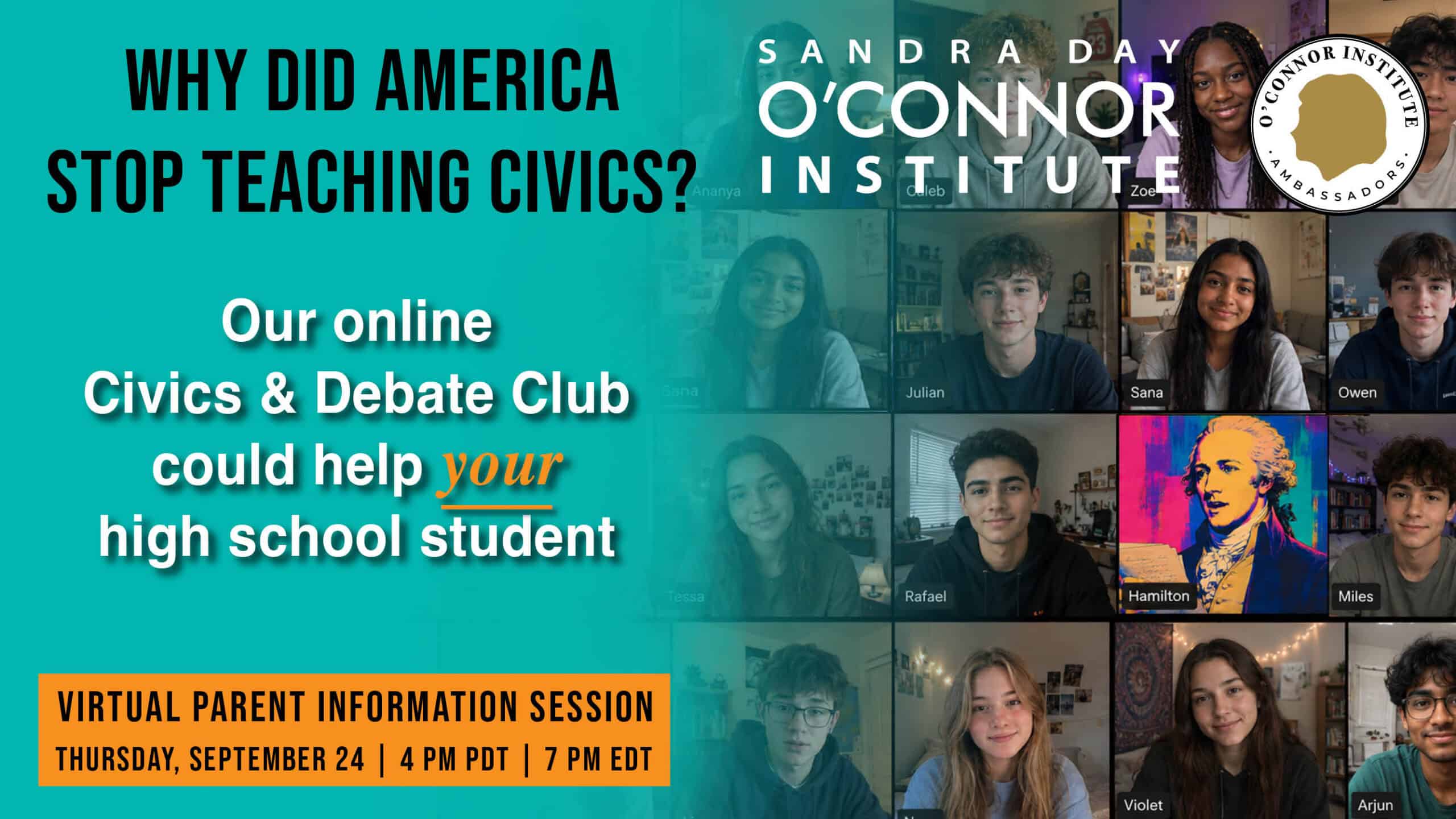
The O'Connor Institute Ambassadors Civics & Debate Club
The Ambassadors Civics & Debate Club is a free, online extracurricular open to 9th–12th graders nationwide. No debate experience is required — just curiosity.
What students get:
- Monthly live discussions (Zoom, September–May) on civics topics tied to real-world issues
- A private app for ongoing conversation and resources between meetings
- Connections with engaged peers across the country
- A stronger college application
- Eligibility for $500 community service awards and $5,000 senior scholarships
- A graduation cord recognizing their participation
How it works for parents: Students express interest by clicking to join and fill out a simple application. That's it! Then look for regular updates in your student’s inbox (and yours) with meetings, programs, scholarships, and more.
Community service award applications are due October 16, 2026.

Why Civics Education Matters
American schools teach less civics than they used to — and it shows. Here's what the research says, what's happening in your state, and how your student can build real civic skills through the O'Connor Institute.
"In over half the states in the union, civics education is not required. The only reason we have public school education in America is because in the early days of the country, our leaders thought we had to teach our young generation about citizenship ... that obligation never ends." — Justice Sandra Day O’Connor
Civic knowledge doesn't happen automatically — it has to be taught. Yet over the past several decades, civics instruction has steadily lost ground in American classrooms to other academic priorities.
The Sandra Day O'Connor Institute's original research digs into how this happened and what it means for students today:
- When and Why Did America Stop Teaching Civics? (2024) — traces the decline in civics instructional time, which began dropping sharply in the 1960s as schools shifted focus toward STEM and standardized testing.
- Why Are Teachers Uncomfortable Teaching Civics? (2025) — examines why many educators feel unprepared to teach civics, and what that means for the classroom experience your student is actually getting.
- New Evidence on Trickle-Down and Trickle-Up Influences in Civic Education and Engagement (2023) — looks at how civic habits move between generations and institutions.
This research has been cited by RealClearPolitics, Education Week, the Chicago Tribune, and Arizona PBS — helping shape the national conversation about restoring civics education.

Civics Requirements Vary Widely by State
36 + D.C.
states require a civics course to graduate high school
29
states require students to take a civics assessment
2
states require students to pass a civics exam to graduate (Ohio and Virginia)
Whatever the exact number, the trend is clear: civics is treated as optional in far too many places — and that gap is exactly what the Institute's Ambassadors program and research aim to close.